Free Inquiry Now !

Environment Dictates Performance: Why Context Matters More Than Material
Fifteen years in lighting engineering, and I’ve lost count of the projects where “the right material” still failed spectacularly. Take a client last year—top-tier acrylic diffuser panels specified for their office fit-out. Three months later, complaints about uneven lighting and yellowing edges. The material specs were flawless; the problem was they’d installed gallery-grade acrylic in a 24/7 commercial building.
What truly determines light diffuser panel performance isn’t lab-measured light transmission percentages. It’s the messy reality of installation: temperature swings, handling frequency, maintenance cycles, UV exposure. These operational details often outweigh optical parameters in long-term project success.
Offices & Commercial Spaces: The Stability Imperative
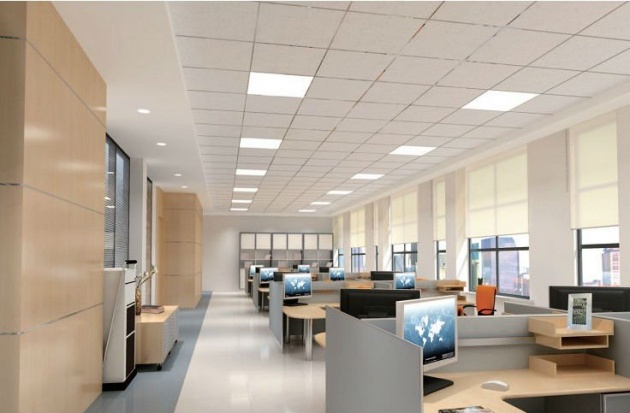
The core pain point in workplace lighting? Not insufficient brightness, but the gap between “set it and forget it” expectations and operational reality. Facility managers dread the six-month mark when color shift, uneven lumen depreciation, and edge warping emerge. Coordinating repairs with building management while disrupting operations—those hidden costs dwarf any initial material savings.
This explains whypolycarbonate diffuser panels have become the default for commercial environments. PC’s heat deflection temperature hits 129°C versus acrylic’s 93°C, maintaining dimensional stability through HVAC cycling. More crucially, polycarbonate’s impact resistance runs 250 times higher than acrylic, preventing micro-cracks during installation and maintenance—damage invisible initially but seeding future optical degradation.
Modern PC diffusers achieve 85%+ light transmission with frosted or opal surface treatments, fully satisfying office uniformity requirements. For commercial real estate chasing “zero-maintenance” credentials, this “good enough and durable” characteristic often trumps acrylic’s marginal 5% transmission advantage.
Installation mechanics matter too. Commercial luminaires typically use recessed or suspended mounting with aluminum frames and spring clips. Polycarbonate’s ductility shines here—minor compression during fitting won’t chip edges, whereas acrylic develops hairline cracks under pressure that propagate over time, eventually compromising optical uniformity.
Retail & Display Lighting: Chasing Optical Excellence
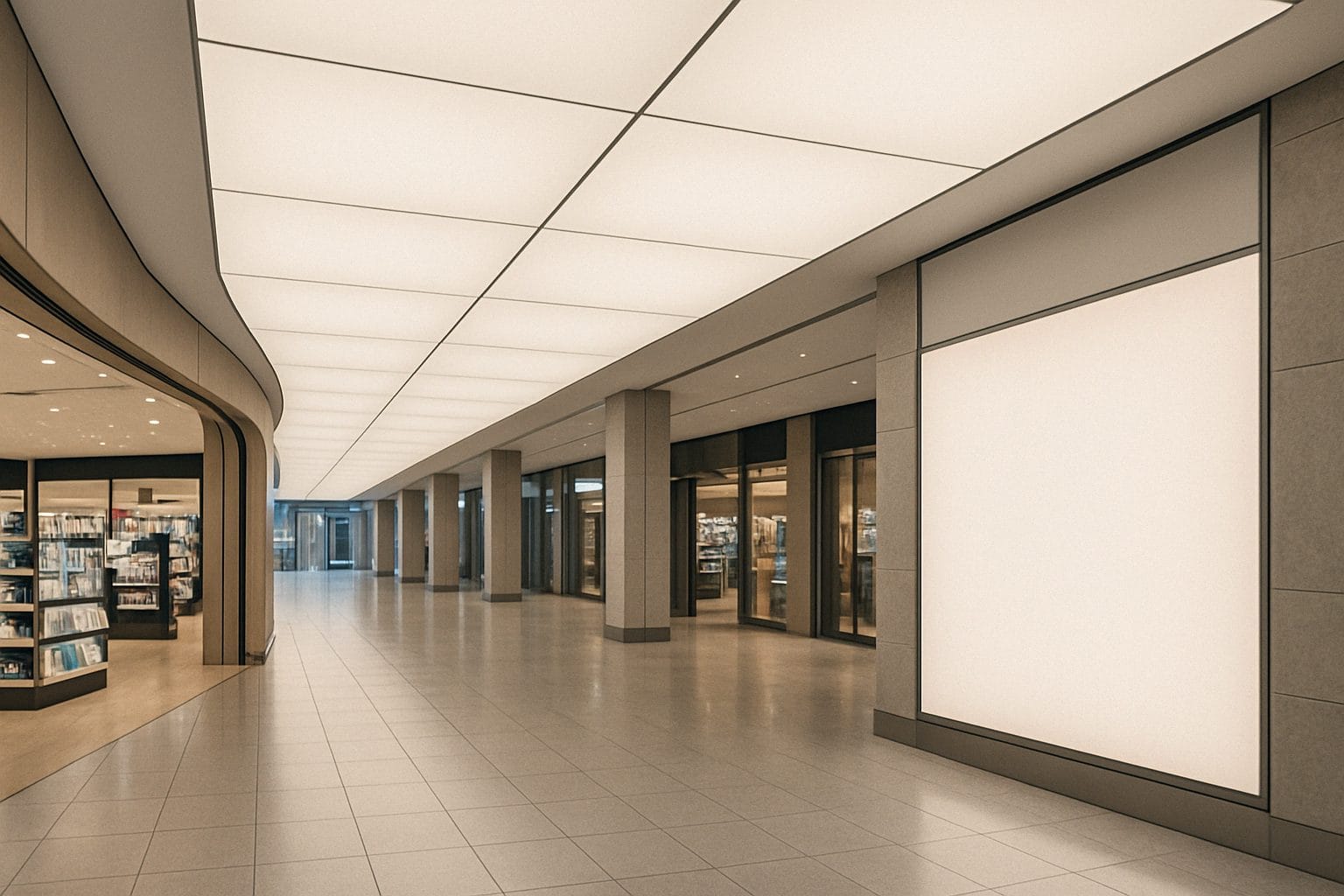
Step into a high-end jewelry boutique or flagship store, and you’ll notice a distinctive lighting quality—bright yet soft, making merchandise appear luminous. This effect relies heavily on acrylic diffuser panels and their optical characteristics.
Acrylic’s headline advantages: 92%+ light transmission with superior color consistency. In retail, lighting isn’t merely illumination—it’s part of the merchandise presentation. Acrylic transforms LED point sources into seamless surface glow, eliminating fixture “pixelation” and creating clean, continuous ceiling light bands. For spaces requiring frequent layout changes, acrylic’s lighter weight and easier fabrication—on-site cutting, heat bending—add practical value.
But here’s the non-negotiable condition: retail environments must be controlled. Climate-stabilized mall interiors, sun-shielded enclosed spaces, professional cleaning protocols. Remove any of these guardrails, and acrylic’s UV resistance gets overwhelmed by thermal expansion stress, triggering catastrophic optical decline.
Industrial & High-Stress Applications: When Toughness Trumps Rigidity
Factory floors, warehousing, public transit—these environments share DNA: vibration, impact, dust, chemical cleaning. Here, conventional wisdom favoring “harder is better” collapses.
Acrylic boasts high surface hardness and scratch resistance, yet remains fundamentally brittle. Repeated vibration or accidental impact nucleates stress fractures.Polycarbonate’s toughness operates at the molecular level—deforming then recovering rather than shattering like acrylic. For industrial luminaires requiring frequent relamping, or installations near forklift routes and production lines, PC’s survivability directly determines service life.
Another overlooked factor: fire safety ratings. Polycarbonate is inherently flame-retardant; acrylic is combustible. In petrochemical, textile, or other fire-code-intensive industries, this often becomes a binary pass/fail criterion.
Industrial maintenance practices also influence material choice. Facilities pressure-washing fixtures or using aggressive solvents find acrylic surfaces hazing rapidly, while polycarbonate’s chemical resistance proves superior. Lifecycle economics tell the same story—despite 15-25% higher upfront costs, PC’s reduced replacement frequency and downtime penalties typically yield lower total ownership costs.
Outdoor Installations: The Ultimate Durability Test
Outdoor lighting is where light diffuser panel reveal their true character. UV bombardment, precipitation, thermal cycling, wind abrasion—this combination exposes substandard materials within months.
Acrylic offers inherent UV resistance but requires specialized formulations for extended outdoor service. Standard polycarbonate is UV-vulnerable, demanding co-extruded UV coatings or absorber additives. Premium outdoor-grade PC panels employ dual-sided UV protection, maintaining stability from -40°C to 120°C.
Critical for outdoor deployment: thermal expansion accommodation. PC’s linear expansion coefficient runs roughly 1.5× acrylic’s, meaning wide-temperature-range installations must incorporate sufficient expansion gaps. Otherwise, summer heat causes buckling; winter contraction induces mounting stress. Many premature outdoor failures trace to installation details rather than material defects.
Market data confirms this segment’s growth trajectory. Global Market Research valued the 2024 light diffusion film market at $7.4 billion, with outdoor and industrial applications representing the fastest-expanding categories. This demands suppliers evolve beyond material provision toward environmental application support—installation guidance, expansion joint calculations, mounting method recommendations.
LED-polycarbonate-diffuser
Conclusion: Selection as Systems Thinking
There’s no universal “best” diffuser panel, but there is a systematic approach. Define environmental constraints first (temperature, humidity, mechanical stress, UV exposure). Clarify optical objectives (transmission, uniformity, glare control). Then evaluate long-term reliability—this framework serves virtually any lighting project.
Whether polycarbonate’s rugged dependability or acrylic’s refined transparency, either material only delivers value in its proper context. As designers or procurement professionals, our job isn’t selecting “the best material” but identifying “the least wrong choice” for each specific scenario.
FAQ
1: What’s the recommended diffuser material for office lighting?
A: Prioritize polycarbonate. Commercial environments demand long-term stability; PC’s tolerance for temperature fluctuations and handling during maintenance reduces lifecycle costs effectively.
2: Can acrylic diffuser panels work for outdoor projects?
A: Possible, but requires careful evaluation. While acrylic offers UV resistance, its temperature range and impact tolerance lag behind modified PC panels. Reserve it for semi-outdoor applications with minimal thermal variation and no mechanical impact risk.
3: Why does my lighting look uneven despite using premium diffuser panels?
A: Typically three installation factors: insufficient mixing distance between LEDs and panel, thickness-structure mismatch, or edge mounting restricting thermal expansion. Audit installation protocols before blaming material selection.